Showing posts with label Non-Royal. Show all posts

Thursday, December 22, 2011

Readers' Top 15 Tiaras: #3. The Fife Tiara

Our countdown of your favorite tiaras continues with...

#3. The Fife Tiara

Coming in at number three, we have a tiara that hasn't been seen in public for a long, long time. And unless following the many and varied descendants of Queen Victoria is a personal hobby of yours, there's a good chance you're not that familiar with its wearers. But never mind that. Just loooook at it:
The Fife Tiara
The Fife Tiara is the third tiara on your list to hail from a noble family, but this time we have a royal beginning. It first belonged to Princess Louise of Wales, the oldest daughter of King Edward VII and Queen Alexandra. When she married the Earl of Fife in 1889, she received quite a waterfall of sparkling presents; this stunning tiara with pear-shaped diamonds hanging freely in a diamond framework, topped with more pear-shaped diamonds alternating with round diamonds, was among them. It is thought to be the work of Parisian jeweler Oscar Massin. This is sometimes said to have been a gift from her parents, but contemporary reporting of her wedding gifts attributed it to the Earl (who was made the Duke of Fife by Queen Victoria right after the wedding). Her parents' gift, on the other hand, is described as a classic convertible diamond fringe tiara.
Princess Louise, the Princess Royal and Duchess of Fife
Poor Louise is something of a background figure in royal history. She wasn't as pretty as her mother or her sister, Victoria, and she wasn't as notably married as her sister Queen Maud of Norway. Apparently a rather difficult person to make conversation with, she earned herself the title "Her Royal Shyness" and was most known for her talents in the realms of music and fishing. Her marriage to the Duke, who was 18 years older, seems to have done her a world of good - as, no doubt, did the escape from the smothering atmosphere of her parents' home. She was one of the first princesses to marry a subject rather than a prince but Queen Victoria approved of the union, noting that the groom was extremely rich.
Princess Louise
Louise was given the title of Princess Royal, but didn't play a large role in the royal family. Her ill health was a continual problem, and she escaped to warmer climates each winter. While en route to Egypt for the winter of 1911, the Fife family was shipwrecked off the coast of Morocco. Though they all survived, the ordeal took a toll on the Duke's health, and he passed away the following month.
The Duchess of Fife (left - wearing the Fife Tiara and the fringe tiara from her parents around her neck) and Queen Alexandra (right - wearing the kokoshnik tiara now worn by Queen Elizabeth) with Alexandra's mother, Queen Louise of Denmark (center)
Louise had three children: a stillborn son followed by two daughters, Alexandra and Maud. Because it was known in advance that there would be no Fife son to inherit the title, Queen Victoria made a special dispensation for inheritance in the female line. Accordingly, Princess Alexandra became the Duchess of Fife in her own right when her father died. Later she was also known as Princess Arthur of Connaught through her marriage. As she was predeceased by her own son, the title passed down to her nephew, James Carnegie. So far as we know, the tiara is still with the family.
Princess Alexandra, Duchess of Fife
Tiara occasions for the Fifes are very rare, which is terribly sad for us jewel lovers. This one in movement would be absolutely spectacular. Mounted in gold and set in silver, the largest diamonds freely articulate inside their diamond arches. That means that they would tremble with the tiniest movement of the wearer's head, capturing and reflecting the light constantly.
Caroline, Countess of Southesk, daughter-in-law of the current Duke
This has always been a favorite of mine. It has enormous individual stones and the design is very spiky, like a Gothic fence of some sort (the prettiest Gothic fence ever). And yet, I think delicate is a perfectly applicable word to describe it. That's what's remarkable about this, what makes it a triumph of workmanship and design, really: it retains a certain lightness despite the staggering carat weight on display.
Quite frankly, I find it breathtaking - especially at first glance. I'm not at all surprised that this made it so high on the list, even with a low-key history and essentially no contemporary outings and no well-known wearers.

Did you know about this tiara prior to our little voting extravaganza, or are you a new convert?

Photos: Geoffrey Munn/The Royal Collection

Friday, December 16, 2011

Readers' Top 15 Tiaras: #8. The Portland Sapphire Tiara

Our countdown of your favorite tiaras continues with...

#8. The Portland Sapphire Tiara

Here’s a surprise entry to the list, and our first tiara without a royal wearer in its history. If you’re feeling wordy, you can call this baby the Portland Antique Sapphire, Diamond and Natural Pearl Tiara, but for heaven’s sakes I think a simple “Portland Sapphire Tiara” name will do for our purposes.
The Portland Sapphire Tiara
Your eyes will fill in the rest for you: it is indeed composed of sapphires (Burma and Ceylon), diamonds, and pearls (natural saltwater). Specifically, there are twelve clusters of cushion-shaped sapphires and old-cut diamonds set in a circlet of diamond husks and swags. The tiara is bordered with diamonds with pearl finials and sapphire accents, and the whole thing is mounted in silver and gold. Its inner circumference measures 54 centimeters (go ahead, measure your head and see if the glass slipper fits, I’ll wait here).
The tiara worn by a Christie's employee. In related news, I think I just found my dream job.
Our "Portland" name comes from the tiara's family, of course: the tiara was created by E. Wolff & Co. for Garrard shortly after William Cavendish-Bentinck, the 6th Duke of Portland, married Winnifred Dallas-Yorke in 1889. In the true tradition of owning jewels for use and wear instead of museum-like adoration, this tiara is a composite of other family jewels that were broken down to create it. A matching stomacher predates the tiara and may have served as a design inspiration.
Left: Winifred, Duchess of Portland, wearing a different Portland tiara for the coronation of King Edward VII (she was Mistress of the Robes and a canopy bearer at the ceremony for Queen Alexandra). Right: the stomacher at auction.
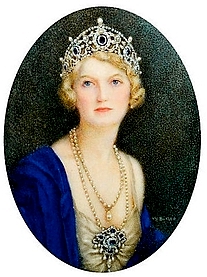
About the only representation publicly known of a family member wearing the Portland Sapphire Tiara is a miniature of Ivy Cavendish-Bentinck, wife of the 7th Duke, and Winifred's daughter-in-law. Ivy and her husband William had two daughters but no sons to inherit the dukedom. The title passed to William's third cousin (and has since died out due to lack of male heirs; the earldom of Portland lives on instead), but he made sure that the family fortune (including jewels) stayed with his eldest daughter, Lady Anne Cavendish-Bentinck.
Ivy Cavendish-Bentinck, when she was Marchioness of Titchfield
Lady Anne died in 2008, and her wealth was inherited by her nephew, William Parente. In 2010, a selection of the family's best jewels, including your 8th favorite tiara, was auctioned by Christie's. (The timeline seems to indicate another sale to pay inheritance taxes.) The Portland Sapphire Tiara was initially valued between £250,000 and £300,000 but sold for £763,650 ($1,188,239). In fact, though it garnered plenty of publicity, the tiara wasn't even the most valuable jewel for sale. The collection included some very high quality diamonds and pearls; a 9.2 carat Burmese ruby ring fetched £2,169,250 ($3,375,353). As tends to be the way with auctions, the bidding was anonymous, so we don't know where these jewels are today.
Other Portland jewels from the same auction, and the ruby ring which garnered the highest price  
It’s always sad to see pieces auctioned, but I doubt this tiara would have made our list without the auction publicity. Surely we wouldn’t have this many photos or details about it, so there’s that. And for the rest, we’ll just have to hope that someone is giving it a good home and hasn’t broken it up or something ghastly like that.

Does this make your personal favorites list?

P.S.: The countdown resumes Monday!

Photos: Christie's/Getty Images

Tuesday, December 13, 2011

Readers' Top 15 Tiaras: #13. The Spencer Tiara

Our countdown of your favorite tiaras continues with...

#13. The Spencer Tiara

Despite its largely royal association, this is actually the first non-royal tiara to make a featured appearance here in our sparkly house. The Spencer Tiara belongs to the family of the late Diana, Princess of Wales, but it was worn so often by her that some people assume it is a royal piece. It’s not the only tiara owned by the Spencer family, but as it’s the best known we’ll stick with plainly calling it by their name alone.
The Spencer Tiara
Though this piece was once said to date from the 18th century, it actually seems to be a combination of pieces of varying ages and from different jewellers that has gone through several changes over time. The center element was a wedding gift from Lady Sarah Spencer to Cynthia, Viscountess Althorp (Diana’s grandmother), in 1919. This piece was remounted by the Goldsmiths and Silversmiths Company at some point, and Garrard was asked to create four matching pieces in 1937 to add on. The oldest bits are at the ends; these are said to have come from a tiara once belonging to Frances, Viscountess Montagu and left to Lady Sarah Spencer in 1875. The full current appearance apparently dates from around 1935.
Lady Jane and Lady Sarah Spencer at their weddings
The tiara includes diamonds in silver settings mounted in gold in various floral shapes: stylized tulips, star-shaped flowers, and scrolling foliage. It was worn by both of Lady Diana Spencer’s older sisters, Jane and Sarah, at their weddings before it made its infamous debut at Diana’s wedding to Charles, the Prince of Wales in 1981.
Diana on her wedding day
Diana memorably wore it anchoring her veil with her blusher veil attached separately to the front instead of dragging over the top of the tiara. She kept the veil down throughout her wedding ceremony and had the makeup artist cut the front portion off while signing the register.
Diana, Princess of Wales in the early years of her marriage
As the Princess of Wales, Diana continued to wear her family’s tiara. The Queen had given her the Cambridge Lover’s Knot Tiara to use, but the Spencer was lighter and easier to wear. Plus, you can’t argue with wanting a second option, or wanting to show your pride for your own family.
Diana later on in her life
The design of this one makes it easy to love. It’s feminine - girlish, really - and whimsical, as though it might once have been a doodle around the edges of a fairy tale page. And it made a wonderful match for Diana’s image as a young princess in her poufy evening gowns. I think it did her a bit of a disservice as she matured, though; it almost seems ironic to wear such a dreamlike design in a life that was quickly and publicly losing its dreamy sheen.
Charles and Victoria Spencer on their wedding day
As I said, the tiara never belonged to Diana; she borrowed it from her father and then her brother. In fact, the borrowing arrangement has long been rumored to have been the source of some family tension. Charles Spencer’s first wife, Victoria, did wear it when they married in 1989. Today, the tiara is on tour with the exhibit Diana: A Celebration.
Given that this one has such a magical design and such a beloved former model, I’m not at all surprised this made your list. Some mentioned the “first impressions” rule in their tiara votes: that the first tiara you ever saw will forever have a spot in your affections. And so I can’t help but wonder...

How much does that “Diana factor” contribute to your feelings about this tiara?

Monday, December 12, 2011

Readers' Top 15 Tiaras: #15. Queen Victoria's Sapphire Coronet

Our countdown of your favorite tiaras begins with...

#15. Queen Victoria's Sapphire Coronet

My request for your favorite tiaras sparked a right royal campaign for one piece in particular: commenter Faerieeva dutifully promoted a wee sapphire gem from Queen Victoria’s stash. Well, Your Faerieness, you win. (Hey, I told you this wasn't a scientific poll.)

Design was among the many progressive interests of Prince Albert, Queen Victoria’s husband, and that interest extended right into his wife’s jewelry collection. As the Queen herself wrote, “Albert has such taste and arranges everything for me about my jewels.” He designed several pieces of jewelry for her over the years, including this petite sapphire and diamond tiara that I will dub Queen Victoria’s Sapphire Coronet.
Likely inspired by a diadem from a portrait of Queen Henrietta Maria, the tiara was probably commissioned from Joseph Kitching in 1842 at a cost of £415. The sapphires - both cushion- and kite-shaped - are set in gold, and the diamonds are set in silver. I'm calling it a coronet because Queen Victoria referred to it as such in her own records, and because it does bear a resemblance to the base of those mini-crowns we associate with coronations.
Queen Victoria
This was one of the pieces that was small enough for Victoria to deem appropriate for use during her subdued widowhood. But after she passed away, this flexible Gothic design went unseen as Queen Alexandra and Queen Mary focused on larger tiaras. It finally surfaced again in 1922 when Princess Mary, the only daughter of King George V and Queen Mary, married Viscount Lascelles. Henry Lascelles would eventually become the Earl of Harewood, and Mary the Countess. The King gave his grandmother’s tiara, along with a matching parure, to his daughter as a wedding gift.
Princess Mary's wedding gift
Popular consensus seems to be that 24-year-old Mary was forced to marry her 39-year-old groom in an arranged marriage, though the oldest of their two sons, George, would refute claims their marriage was unhappy in his memoirs. George became the Earl of Harewood upon his father’s death in 1947.
Princess Mary, the Princess Royal and Countess of Harewood
Mary died in 1965, and the years following her death saw her family auction off quite a chunk of her jewel collection. This tiara, however, managed to stay in the family. At the least, it has been worn by Patricia, Countess of Harewood (George’s second wife) and by Andrea Lascelles at her wedding to the Earl’s fourth son, Mark, in 1992.
The Countess of Harewood and Andrea Lascelles
Without a royal wearer, though, the tiara fell out of the public eye. While putting together an exhibition for Wartski’s in 1997, Geoffrey Munn wrote to the Earl wondering if he had any pieces with royal provenance. His inquiry prompted what must have been an amusing call from the Countess, telling him that they had just one and it was “so small you probably will not want it.” Naturally, he did want it, and it was exhibited in 1997 and again at the Victoria and Albert Museum (appropriately!) in 2002.
Unless it has been sold very quietly, we can assume that the family still has the tiara today. It must be noted here, however, that George Lascelles passed away in July 2011, and his son David has now inherited the title. As we know, inheritance taxes are usually a prime culprit in making families sell off their jewels. There is no doubt this piece and its significant history would fetch an absolutely enormous sum at auction.

Is this on  your personal list of favorites?

Photos: V&A/Illustrated London News/Majesty/Geoffrey Munn